

There’s a scene I keep seeing when visiting garage warehouses: two rows of shelves overflowing with colorful plastic containers, labeled in both English and German, many bottles opened but less than a third used. Upon closer inspection, most were purchased based on recommendations from colleagues or online videos, rather than any logical basis. The result is that the workshop suffers from both heavy inventory and a shortage of the most crucial components. The problem isn’t the products themselves, but the lack of a comprehensive roadmap. The automotive care market currently has thousands of product codes, but when categorized by function, they can be neatly grouped into nine major categories, each with a distinct role and a nearly fixed position in the process. This article will redraw that roadmap, so you know what each category does, where it stands, and why no group can replace another.
Nine Product Groups and Process-Based Arrangement Logic
The most useful categorization method isn’t based on brand or price, but on how the product affects the surface and at what stage of the process. Following this axis, pre-wash and snow foam handle coarse dirt before it even touches the paint; car wash solutions handle controlled contact cleaning, removing dirt and impurities that soap can’t remove; and paint correction addresses the clear coat and protective sealant layer. Three groups are further categorized by area: interior, glass, and wheels/tires, as each area has its own specific dirt types; finally, there are tools and equipment used throughout the process. Understanding this map, managers can avoid expecting a single multi-purpose product to replace four specialized products, and avoid purchasing three identical products. For dealerships, this is also a sales tool: ask customers which step is missing and point them to the corresponding group, just as Vncar Solutions organizes its import catalog.
The Pre-Wash and Foam Group, First Line of Defense
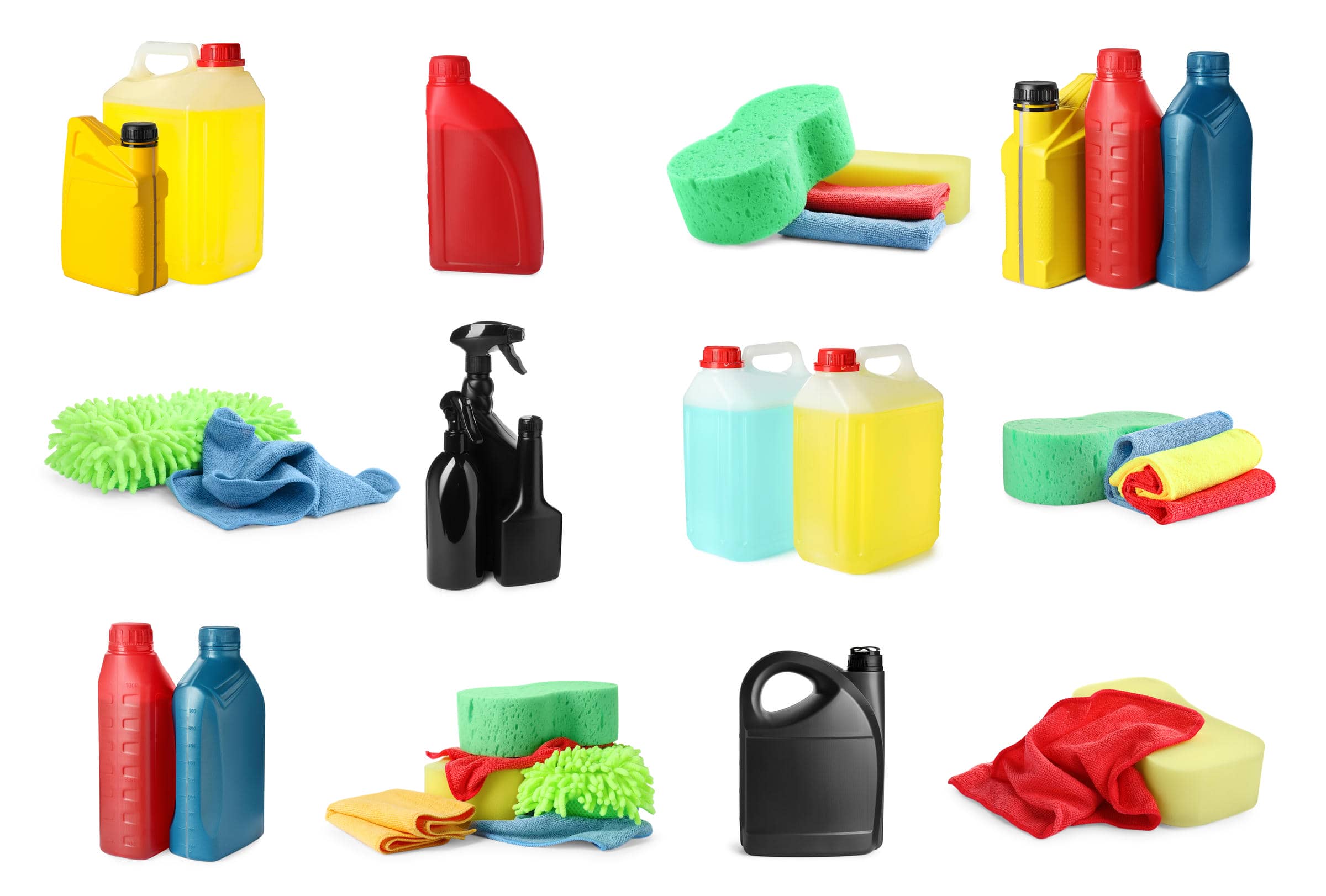
The pre-wash group includes snow foam, pre-wash solution, traffic film remover, and products to remove insect residue and mud from wheel wells. Their common purpose is to soften and then wash away coarse dirt using chemicals and water pressure before gloves or cloths touch the paint. This group determines whether the car will develop swirl marks, as any remaining sand particles will become sandpaper in the next step; it always comes first, right before the contact wash. Most products are alkaline-based to cut through oil and grease; the difference lies in adhesion: good foam should be thick and stay on the car body for five to ten minutes, as contact time is necessary to dissolve dirt. Koch Chemie, ValetPRO, and Cartec all have lines for lightly and heavily soiled cars, with varying dilution levels. In Vietnam, road dust mixed with diesel fuel and acid rain means that a car driven in the city for a week requires a stronger product. The only thing to note: do not let the foam dry in the sun.
Car Wash Solution Groups and the Boundary Between Neutral and Strong Detergents
Car shampoo is the most misunderstood type of car wash solution because everyone thinks it only needs to create foam, while its main function is to lubricate the surface, helping the washcloth glide over the paint instead of dragging dirt particles. The most commonly used type is a pH-neutral shampoo, which cleans sufficiently but doesn’t strip away existing wax, sealant, or coatings. Another type, containing polymers or SiO2, both cleans and replenishes a thin layer, suitable for weekly maintenance washes. The other type is strip wash, which is distinctly alkaline, stripping away old protective layers, silicone oils, and product residue, leaving the surface bare before polishing or coating, and is therefore only used once per cycle. A common mistake at typical car washes is using strong detergents, even dish soap, on all cars. The consequence is that the protective layer the customer paid for disappears after a few washes, and rubber seals and black plastics gradually fade without anyone understanding why.
Intensive Stain Removal Group for Painted Surfaces
After washing, the paint may look clean, but it still retains three types of mechanical contaminants that water and soap can’t remove. Iron remover reacts with metal particles from brake dust and turns purple, immediately indicating the level of contamination. Solvent-based tar remover dissolves tar and tree sap stains on the lower body and front bumper. Mild acid-based mineral removers treat hard water stains and white spots left after the car dries in the sun. Complementing these are mechanical degreasers, including clay, clay gloves, and clay discs, always accompanied by a lubricant, which pull out any remaining contaminants embedded in the surface and restore the smooth feel through a thin plastic bag. Clay is mildly abrasive, so sufficient lubrication is necessary, and pieces that have fallen to the ground should not be reused. This is the easiest group of degreasers for garages to cut corners on during a quick run, but it determines how long the subsequent coating will last.
Paint Correction Group Includes Polishing Pads and Pads
Paint correction is where the product begins to remove material, not just clean, and is categorized into three cutting levels. Coarse-cutting compound, containing large abrasive particles, is used to smooth out deep scratches and long-standing oxidation, but always leaves a dull finish requiring further processing. Medium-cutting compound removes most common swirl marks while maintaining clarity, and finish compound does almost no cutting, only refining to a mirror-like shine; Menzerna, Koch Chemie, 3M, and Rupes all build their product lines around these three levels. But compound is only half the story: the same bottle of compound, when fitted with a sheepskin pad, provides significantly more cutting power than a soft foam pad, so the result is always a combination of compound, pad, machine speed, and technician skill. Pads are categorized by hardness, from strong cutting to soft finishing, with microfiber pads offering high cutting power and low heat generation. This group also includes a test wipe solution to help distinguish between truly removed swirl marks and those temporarily masked by the oil in the compound.
Surface Protection Products: From Wax to Coating
Once the surface is clean and smooth, the protective coating group seals off all the work done upfront, with four main branches. Natural wax-based coatings offer warm color depth but have a shorter lifespan; polymer-based sealants are more durable and provide a sharper gloss. SiO2 or SiC-based ceramic coatings create a semi-permanent bond to the clear coat, lasting for years but requiring meticulous application. Finally, there’s PPF paint protection film, a physical solution against stone chips, often applied over a coating. A very useful side branch is quick-drying spray products including quick detailers, drying aids, and toppers for coated vehicles: these don’t replace the main protective layer but replenish and restore the water tension that gradually decreases after a few months. Because the usage cycle is only weeks, this is also the easiest group to sell as an add-on. A serious coating shop must always have compatible maintenance products on hand, otherwise high-end coatings will lose performance sooner than expected.
Interior Care Group for Multiple Materials Simultaneously
The interior has the highest density of materials in a car, so the product range serving it is the most diversified. At the heart of the range is APC multi-purpose cleaning solution, diluted in various ratios for hard plastics, floor mats, and door trim. The leather cleaning duo includes a mild pH cleaning solution and a conditioning cream, removing dirt from the leather grain while restoring moisture and protection. The dressing group restores color and prevents UV aging for the dashboard, with both glossy and matte finishes available to suit customer needs. Fabric cleaning requires a spray and suction machine to remove deep-seated stains from the foam. The deodorizing group is divided between temporary odor masking and those that treat the root cause using enzymes or oxidizing gases. Finally, there are air conditioning cleaning products, attacking mold on the evaporator coil, the real cause of the odors many people blame on the seats. In Vietnam’s hot and humid climate, the last two branches are almost mandatory seasonal services.
Glass, Wheel, and Tire Care Group for Difficult Surfaces
Glass requires a separate cleaning process because its surface is much harder than paint and the types of dirt are quite different. First, an ammonia-free glass cleaner is used for dust and fingerprints. Next, an oil film remover is used to eliminate the hazy film from exhaust fumes and oil smoke, the culprit behind glare from oncoming headlights at night. More serious cleaning involves removing hard water stains and using cerium oxide-based glass polish; only after the glass is completely clean does a water-repellent coating apply, which helps water droplets form into droplets and be expelled at high speed. Nanolex, Gyeon, and Sonax all offer complete systems for this. Wheels and tires face the harshest types of dirt: a pH-neutral wheel cleaner that changes color and is safe for all types of wheels, used periodically; strong acid or alkaline cleaners are only for long-standing melted brake dust and require extreme caution regarding contact time. Tires, in particular, require an alkaline solution to remove old, browned anti-aging coatings, a step many mechanics skip, so the applied tire conditioner will fade after a few days.
The Tools, Accessories, and Equipment Group Determines the Final Result
The last group is often overlooked but largely determines the quality of the output, because even the best chemicals need a tool to reach the car’s surface. Microfiber towels are the clearest example: the fiber count, weave, and hemming determine whether the towel absorbs well or leaves lint, glides smoothly or drags scratches. Professional workshops always sort towels by color for each task and never wash them with fabric softener. Also in this group are long-fiber cleaning gloves that trap dirt particles, buckets with strainers, coating applicators, and solvent-resistant sprayers. At the equipment level, the list expands to include pressure washers, dual-orbit polishing machines, spray-extraction washers, paint defect inspection lights, and paint thickness gauges. Experience in supplying detailing centers shows that it’s best to complete the consumables group first before moving on to larger equipment, because a high-end polishing machine paired with inferior towels won’t make a significant difference.